Jamie Gibson Masonry Services
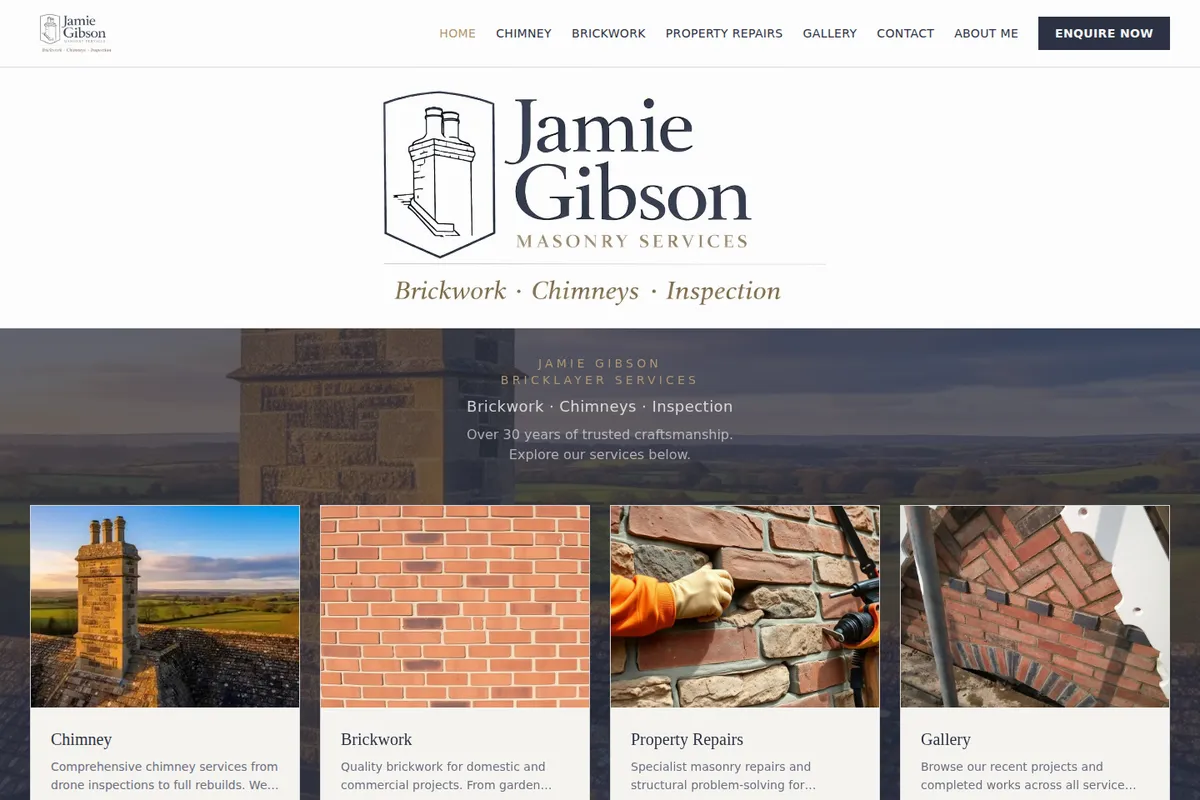
How a Birmingham bricklayer’s website went from 8 pages in Google to a fast, fully indexable site that scores 100 on Google PageSpeed.
The client
Jamie Gibson is a bricklayer in Birmingham with over 30 years of experience, covering brickwork, chimneys and property repairs across the West Midlands. His work ranges from chimney drone inspections and chimney repointing to garden walls and small builds.
The problem
The first version of Jamie’s website was built with an AI site builder. It looked good, but Google couldn’t read it properly. Every page was delivered to Google as an empty shell, with the same title, the same description and a canonical tag pointing back to the home page. To Google, 27 different pages looked like 27 copies of one page.
The result: only 8 pages were indexed, and 15 were sitting in Search Console as “Discovered, currently not indexed”. Pages written to win local searches were invisible. The contact forms also weren’t sending enquiries anywhere.
What I did
I rebuilt the site in Astro as a carbon copy first, checking every page, heading, link and image against the original so nothing was lost. Then I switched the domain over in Cloudflare without changing a single URL, so no redirects were needed.
- Real pages for Google. Every page now arrives as finished HTML with its own title, description and canonical tag.
- Local landing pages that can rank. Dedicated pages for chimney repairs in Birmingham, brickwork repairs in Birmingham, Coventry chimney services, Sutton Coldfield chimney repairs and chimney restoration in Lichfield.
- Working enquiries. The contact and quote forms now deliver every enquiry to Jamie’s inbox, with spam protection, and each one is tracked as a conversion in Google Analytics.
- A Recent Work section. Each job gets its own article with site photos, such as this cavity tray repair in Harborne. Adding a new job is one text file and a few photos; the images are resized and the sitemap updated automatically.
- Search Console clean-up. A dated sitemap, a www-to-main-domain redirect, and a homepage H1 chosen from the searches Jamie was actually appearing for.
The results
Google PageSpeed Insights, mobile, home page:
- Performance: 73 before, 100 after
- Accessibility: 96 before, 100 after
- Best practices and SEO: 100
- Agentic browsing: 2/2 before, 3/3 after, with an
llms.txtfile so AI assistants can understand the business
Within two weeks of the switch, indexed pages nearly doubled, from 8 to 15, and Google is still working through the rest. Speed came from self-hosted fonts, correctly sized WebP images and loading analytics only when needed, while keeping the look of the original design.
What this shows
AI tools can produce a good-looking website in minutes. What they often miss are the basics that decide whether anyone finds it: what Google actually sees, page speed, and forms that work. That gap is where an experienced web developer earns their keep. If your site looks right but isn’t bringing in enquiries, get in touch and I’ll take a look.